Thursday, 6 August 2026 Stay informed. No noise.

Singapore Tourism Board and Grab join forces to elevate visitor experiences

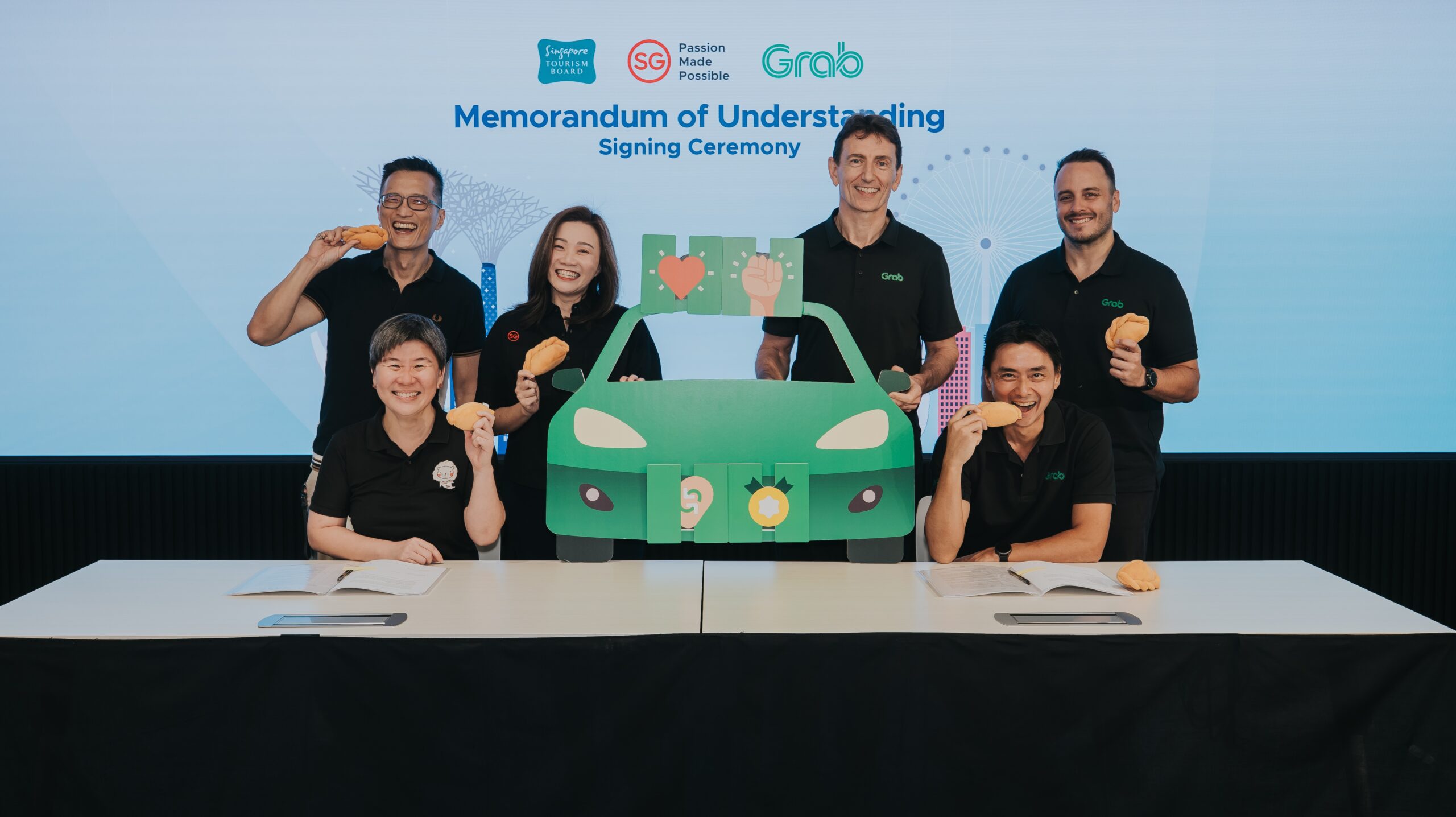
The Singapore Tourism Board (STB) and Grab, Southeast Asia’s leading superapp, have announced a partnership to enhance visitor experiences and strengthen Singapore’s position as a top travel destination. Through a newly signed Memorandum of Understanding (MOU), both organisations aim to attract more international visitors and drive tourism spend, while delivering seamless and authentic travel experiences across the city.

At the heart of the partnership is a shared ambition to strengthen Singapore’s position as a destination that consistently delivers value, discovery and seamless experiences at every step of the traveller journey. By combining STB’s expertise in destination marketing and partnerships with Grab’s technology and insights into dining and commuting trends, the collaboration seeks to empower travellers of all profiles to explore Singapore’s diverse precincts with greater ease and relevance, ensuring they get the most value from their trips.

The mutual sharing of data insights plays a key role in helping both organisations better understand evolving traveller behaviours and uncover more meaningful experiences for visitors. This aligns with STB’s Tourism 2040 roadmap by cultivating visitor demand, enhancing Singapore’s attractiveness as a destination and driving quality tourism growth.

“Visitors today seek good value and unforgettable experiences when they travel – and Singapore is a compact, yet exciting destination that delivers on both. Together with Grab, we hope to inspire more travellers to consider Singapore, and when they are here, to make every ride an adventure. Grab’s extensive reach and capabilities, coupled with STB’s destination know-how, will help us understand our customers better, while making it easier for them to discover more, and get the most out of every moment in Singapore,” said Mr Terrence Voon, Executive Director for Southeast Asia at STB.

Enhancing Value for Travellers

As part of the collaboration, STB will act as the gateway connecting Grab with tourism partners across Singapore to enable closer collaboration. Deeper insights gained from these partners, combined with Grab’s demand generation tools and marketing capabilities, will help drive greater footfall and tourism spending throughout the island — benefiting a wide array of local businesses and experiences.

One key initiative is the enhancement of the Grab Travel Pass, a convenient bundle offering discounts on Grab transport and services in-country. Available to all international travellers visiting Singapore, the Travel Pass simplifies travel planning and improves on-ground mobility, delivering greater value to travellers while driving growth for tourism partners.

Leveraging Singapore’s strength as a hub for global and regional events, the partnership will also see Grab collaborating with STB and event organisers to elevate the overall event experience through its mobility, food and financial services which are widely used by both leisure and business travellers.

Spotlighting Singapore’s Culinary Scene and Supporting Local Businesses

Food has long been one of Singapore’s strongest tourism draws — not just because of its global acclaim, but also the accessibility and authenticity of its everyday dining experiences. From MICHELIN-starred restaurants to local hawker stalls, Singapore offers travellers a diverse and dynamic culinary landscape that reflects its cultural richness.

In recent years, the appetite for these experiences has only grown. In 2024, Food and Beverage (F&B) contributed 14% to Singapore’s tourism receipts, marking a 6.3% increase compared to the same period in 2023 and a significant 73% increase compared to pre-pandemic levels. This growth outpaced other spend categories, highlighting the importance of culinary experiences in Singapore’s tourism landscape.

“One of Singapore’s greatest charms lies in the richness of its everyday experiences — from its distinctive neighbourhoods to the hawker centres and small eateries that define its culinary identity. Through our partnership with STB, we hope to help travellers uncover these authentic moments, showcasing Singapore’s heritage and encouraging deeper exploration of its diverse precincts. In doing so, we not only enrich the visitor experience but also support local businesses by connecting them with a broader international audience,” Alejandro Osorio, Managing Director of Grab Singapore.

To make it easier for visitors to discover and enjoy the city’s culinary offerings, features like Grab’s Dine-Out Discovery — which leverages mapping technology and food reviews to surface highly rated eateries nearby — can guide travellers to explore beyond the usual dining spots, uncovering options in both central districts and neighbourhood enclaves.

In doing so, the partnership plays a key role in supporting local businesses by making them more discoverable to international visitors. Whether it’s a heritage hawker stall, a family-run eatery, or a hidden gem in the heartlands, Grab’s platform helps surface these options through curated recommendations and geo-location tools. This visibility drives footfall not only to neighbourhood F&B outlets, but also to nearby retail shops — connecting travellers with everyday dining and retail experiences across Singapore’s precincts and channeling tourism dollars beyond the city centre.

Sustaining Tourism Momentum

This partnership builds on Singapore’s strong tourism momentum in 2025, with 8.33 million international visitor arrivals recorded in the first six months of this year, and S$8.07 billion in tourism spend in the first quarter of 2025. As competition for global travellers intensifies, collaborations like this are essential for sustainable growth by offering richer experiences and extending the economic benefits of tourism deeper into local communities.

AEON Bank and foodpanda embark on strategic partnership

AEON Bank (M) Berhad, Malaysia’s first Islamic digital bank has officially entered into a strategic partnership with foodpanda Malaysia, the country’s leading online food and grocery delivery platform. This business-to-business (B2B) collaboration aims to increase digital banking adoption among their combined stakeholders and empower Malaysia’s gig economy through innovative fintech solutions, while simultaneously promoting financial inclusion.

The Memorandum of Understanding (MoU) between AEON Bank and foodpanda Malaysia outlines a broad scope of collaboration, including customer acquisition, digital financing, joint campaigns and value-added services for their wider ecosystem of customers, riders, merchants and business partners.

YM Raja Datin Paduka Teh Maimunah Raja Abdul Aziz, Chief Executive Officer of AEON Bank stated, “This strategic partnership with foodpanda marks the beginning of an exciting chapter for AEON Bank. We look forward to providing value to foodpanda riders and merchants by enabling access to digital banking, rewards programmes and services that elevate their experience. By optimising foodpanda’s expansive network and connecting it with AEON Bank’s Shariah-compliant products and AEON Points loyalty programme, we aim to deliver meaningful impacts to the target segments — particularly gig workers and MSMEs — while driving growth and engagement.”

This partnership is strategically positioned to contribute to Malaysia’s rapidly growing food delivery and online grocery sector, where user penetration is expected to reach 34.2% in 2025 and over 14.5 million users by 2030 .

“We are thrilled to join forces with AEON Bank to create real, tangible benefits for everyone in the foodpanda community. For our riders, this partnership goes beyond deliveries — it enables access to tech-driven financial support, microfinancing and financial literacy programmes that can improve their livelihoods. Meanwhile, our merchant partners will have greater opportunities to grow their businesses faster with targeted campaigns and financing solutions to scale their operations. And for our customers, they can expect more value and convenience with exclusive rewards and easier access to AEON’s retail ecosystem. This partnership is more than just a commercial collaboration — it’s about empowering riders, accelerating merchant growth and making every customer experience even more rewarding,” said Tan Ming Luk, Managing Director of foodpanda Malaysia.

Various key programmes will be introduced as part of this collaboration, including co-branding engagement featuring the two mascots; AEON Bank’s Neko and foodpanda’s Pau-Pau. Several initiatives currently in the pipeline are:

For Riders

  • A joint programme to support delivery riders in enhancing their mobility and livelihood, including access to AEON Bank’s digital banking offering, financial tools and essential work resources, such as microfinancing for devices and motorcycle purchases
  • Financial literacy initiative to expand outreach and financial empowerment among the rider

For Merchant Partners

  • Targeted campaigns with AEON Bank for foodpanda’s merchants
  • Financial solutions for merchants through the AEON Bank to Business (AB2B) Programme and financing for wholesale purchases, enabling inventory expansion and business growth

For Customers

  • Special rewards and promotions for customers, while adding value to their foodpanda orders
  • Expanded access across the AEON retail ecosystem, hence allowing customers to purchase groceries online beyond just AEON MaxValu Prime, thereby increasing convenience.

This alliance between AEON Bank and foodpanda Malaysia highlights a shared commitment towards improving the financial well being of the thriving community, driving innovation and supporting Malaysia’s socioeconomic development through digital inclusion. Both brands will leverage each other’s strength, aligned with a strategic mission to provide value based, customer-centric digital financial solutions that will deliver dynamic growth.

Visit the website of AEON Bank and foodpanda for further details and stay updated on exclusive offers on social media.

RHB, Tokio Marine Life and Takaful Malaysia forge exclusive banca partnerships

RHB Banking Group (RHB or the Group) has entered into bancassurance and bancatakaful partnerships with Tokio Marine Life Insurance Malaysia Bhd. (Tokio Marine Life) and its takaful partners – Syarikat Takaful Malaysia Keluarga Berhad (STMKB), and its wholly owned subsidiary, Syarikat Takaful Malaysia Am Berhad (STMAB) (collectively referred to as Takaful Malaysia). These partnerships are formalised through separate Distribution Agreements – between RHB Bank and Tokio Marine Life, and between RHB Islamic and Takaful Malaysia, as well as the Framework Agreement entered into by all parties.

Under the Distribution Agreements, RHB will exclusively sell, distribute, market and promote the conventional life insurance products, the family takaful products and the general takaful products developed by Tokio Marine Life and Takaful Malaysia, in Malaysia. The Framework Agreement is entered into as part of the overall joint operating and governance framework for the banca partnerships.

The exclusive Distribution Agreements will be for a period of 20 years (commenced 1 August 2025), at a Total Access Fee payable to RHB of up to RM1.6 billion. The Total Access Fee reflects the projected insurance and takaful business volume that RHB is expected to generate over the tenure of the Distribution Agreements, including anticipated sales of products through RHB’s network of branches and digital channels. These will contribute positively to the Group’s profit before tax.

Dato’ Mohd Rashid Mohamad, Group Managing Director/Group Chief Executive Officer of RHB Banking Group said, “This long term and exclusive banca partnerships reinforces our commitment to staying relevant to our customers, diversifying our income streams and driving sustainable long-term growth. By deepening our collaboration, we are able to deliver tailored financial solutions, enhance customer experience and unlock meaningful value for RHB as well as our banca partners. This aligns with our PROGRESS27 strategic priorities, which is already in motion, enabling us to deliver broader value to our stakeholders while driving our non-interest income streams.”

“This reflects the strength, resilience and maturity of our partnership. One that we have built over the years of collaboration and shared ambition. We are confident that this next chapter will see us deliver even greater value to the community, combining Tokio Marine’s global insurance expertise with RHB’s local reach and customer trust,” said Toi See Jong, Chief Executive Officer of Tokio Marine Life Insurance Malaysia Bhd.

Additionally, Nor Azman Zainal, Group Chief Executive Officer of Takaful Malaysia said, “This collaboration positions us to scale our takaful offerings and broaden our footprint within the Islamic financial ecosystem. It reflects our ongoing commitment to making ethical, Shariah-compliant protection more accessible to a wider base of consumers across our key markets.”

The product portfolio will continue to evolve in response to customer needs and emerging market trends.

Execution remains key for 13th Malaysia Plan

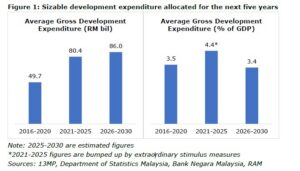
The recently tabled 13th Malaysia Plan (13MP) continues the government’s dual-focus approach of fiscal consolidation alongside sustained support for growth. The headline development expenditure (DevEx) allocation of RM430 bil over five years represents a marked step-up in investment. This translates to an average allocation of RM86 bil per annum from 2026 to 2030, well above the RM79 bil annual average recorded from 2021 to 2024 and nearly double the pre-pandemic average of RM48 bil between 2015 and 2019. Spread evenly, this roughly works out to the government spending at least 3% of GDP on DevEx each year, with more than half of the total allocation (52.8%) directed to the economic sector. This should underpin the much needed infrastructure build-out, human-capital development and innovation-driven projects under the 13MP.

Screenshot 2025-08-07 132000

Realistic Growth Ambition
The plan targets an average annual GDP growth of 4.5%–5.5% over 2026–2030, a range close to the 5.2% average growth recorded between 2021–2024. We believe that this target is both realistic and achievable, and is also similar to our baseline medium-term GDP growth expectation of circa 5.0%, provided global headwinds remain manageable and domestic policy support continues.

Fiscal Consolidation Remains on Track
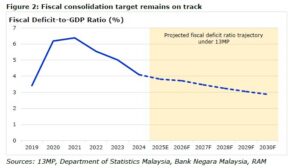
The 13MP reiterated its commitment to narrow the fiscal deficit to below 3% of GDP by 2030, from the 4.1% recorded in 2024. Assuming the total development expenditure is somewhat evenly spread across 2026–2030 and real GDP grows within the targeted range of 4.5%–5.5%, the deficit ratio should be on track to decline toward the sub-3% objective.

Screenshot 2025-08-07 132122

This fiscal consolidation is important to help lower the government’s debt load, which climbed to 64.6% of GDP as at end-2024 from 52.4% in 2019, and in turn ease its debt-servicing burden. Interest payments reached 15.6% of government revenue as of end-2024, up from 12.5% in 2019, which suggests that for every RM100 in government revenue earned, about RM16 is used to pay interest on borrowing. Sustained deficit reduction, therefore, helps avoid the crowding out of productive spending and frees up resources for development priorities over the long run.

Human-Capital and Income Targets
The 13MP aspires to raise compensation of employees (CE) to 40% of GDP by 2030, a commendable target in order to resolve Malaysia’s widely talked about issue of ‘stagnant’ wages. However, this would require an average annual CE growth of 11.1% between 2026 and 2030, more than double the 5.3% pace under the 12MP and higher than the pre-pandemic (2016-2019) average of 7.1%. With CE share at only 33.6% in 2024, achieving this will demand effective wage policies, including continued minimum-wage adjustments, stronger graduate and TVET wage progression, and broad-based productivity enhancements.

The Plan also addresses investments in human capital and preparation as the nation transitions into an aged nation. Latest projections by the Department of Statistics Malaysia indicate that the country will transition into an “aged society” by around 2050, with the working-age population share expected to fall from 70% in 2025 to 68%. Coupled with declining birth rates (total fertility rate of 1.7 in 2023 versus 2.0 in 2013), Malaysia faces a shrinking labour force. The review of the mandatory retirement age, alongside a comprehensive strategy for workforce upskilling and an emphasis on Technical and Vocational Education and Training (TVET) to address skill mismatch issues under 13MP, should help mitigate some of the labour market challenges ahead.

Execution Remains Key
As with previous plans, execution remains the linchpin. The enhanced Policy Implementation Plan and monitoring system known as MyRMK will oversee integrated implementation across ministries. The enhanced transparency, which enables timely course corrections, provides the necessary tools for success. Whether the 13MP targets can be met will depend heavily on the effectiveness of execution and the discipline to follow through with the plans.

The 13MP strikes a prudent balance between fiscal consolidation and growth support, with a sizeable and well-targeted DE envelope and a realistic growth target. While sectoral allocations and digital-innovation drivers are well calibrated, execution capacity and human-capital challenges, particularly the ambitious income share goal, will be decisive. Strong implementation governance, more effective measures to minimise leakages and ensure efficient use of public funds, coupled with supportive policies for wages and innovation, will be critical to realising the 13MP’s 2030 vision.

MyCIF reaches out to MSMEs and entrepreneurs in Sabah

Malaysia Co-Investment Fund (MyCIF) has reached out to micro, small and medium enterprises (MSMEs) in Sabah, for opportunities in funding business expansion and their working capital needs through equity crowdfunding (ECF) and peer-to-peer (P2P) financing.

Sabah Minister of Industrial Development & Entrepreneurship YB Datuk Phoong Jin Zhe officiated the one-day roadshow themed “Empowering Financing, Advancing Growth” in Kota Kinabalu. Around 300 representatives from business associations, government agencies, venture capital, private equity and MSMEs attended the event.

Organised by the Securities Commission Malaysia (SC), the event was supported by Invest Sabah Bhd, a key development partner with deep local networks and strong links to state and federal MSME initiatives.

It featured networking sessions, breakout discussions, and exhibitor booths where participants engaged with SC-registered ECF and P2P platform operators and heard first-hand success stories from companies funded through MyCIF.

MyCIF, Malaysia’s first public-private co-investment model, was set up by the Ministry of Finance under the 2019 Federal Budget. Administered by the SC, MyCIF has since co-invested in over 70,000 campaigns, benefiting more than 9,500 MSMEs nationwide. In 2024, the fund exceeded RM1 billion in total co-investments. It employs a 1:4 co-investment ratio under its General Scheme and a 1:2 ratio for targeted initiatives such as the Food Security and Environmental & Social Impact Schemes.

SC Chairman Dato’ Mohammad Faiz Azmi said that MyCIF has been a game-changer for MSME growth, providing much-needed capital that is often a challenge to access through traditional channels. “The Sabah roadshow is integral to MyCIF’s national outreach, designed to expand awareness of alternative financing among businesses across Malaysia,” he said.

“It provides entrepreneurs a direct insight into how ECF, P2P and MyCIF can fuel their growth at every stage.”

“The government, through MyCIF, continues to support MSMEs as key engines of growth, innovation and job creation. This is evident in the RM40 million allocation under Budget 2025 to further expand access to ECF and P2P financing nationwide,” he said. Invest Sabah Chief Executive Officer Dr. Firdausi Suffian welcomed the collaboration with the SC.

“Partnering with the SC in this event has enabled Invest Sabah to amplify its efforts in empowering local entrepreneurs. This roadshow is a vital platform for MSMEs in Sabah to gain insights and forge connections that can help propel their businesses forward,” he said.

As of 2024, total funds raised through MyCIF co-investments alongside private investments have surpassed RM6 billion, enabling businesses to access funding via ECF and P2P financing platforms. MyCIF has attracted 4.1 times private investments for every ringgit co-invested, demonstrating a strong crowding-in effect.

Over the past six years, MyCIF has played a pivotal role in improving access to alternative financing, fostering the growth of over 9,500 MSMEs in the local entrepreneurial ecosystem.
This reflects the continued confidence and growing interest from both investors and MSMEs in alternative financing avenues. For more information on MyCIF, visit https://www.sc.com.my/mycif.